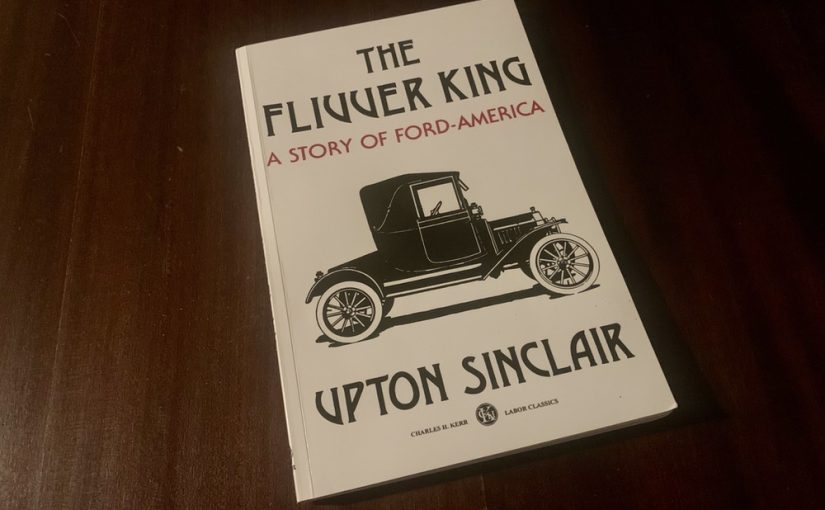
Until now, I knew of Upton Sinclair by reputation only. That reputation rests on The Jungle, his 1906 novel of the meat industry in Chicago, which brought attention and reform. I’ve yet to read that novel, though I’ve considered it and It Can’t Happen Here (1935) many times. In my head, Sinclair is a muckraking journalist, which is a positive thing, in my lexicon. But I had assumed that, as a journalist, non-fiction was Sinclair’s primary mode. But Sinclair’s primary mode for stirring things up was through his novels. The Flivver King is a prime example and one I’d recommend to you without hesitation.
(A “Flivver” is a slang term for a Ford automobile. “Tin Lizzy” is one I’d heard before. “Flivver” was new to me. So, “The Flivver King” is Henry Ford.)
The edition of The Flivver King published by Charles H. Kerr Publishing Company has groovy cover art and a helpful introduction from Stephen Meyer, III (May 24, 1942 – Jun 22, 2020), historian and author of The Five Dollar Day: Labor Management and Social Control in the Ford Motor Company, 1908-1921. Meyer makes a few points relevant here. First, the sections of the novel dealing with the facts of Henry Ford’s life are, to a great degree, factual. The novel moves back and forth between Ford and the Shutt family, who are an invention.
“…Sinclair’s depiction of Ford’s life is quite factual, based on Ford’s ghost-written autobiographies, company publications and newspaper accounts. Sinclair the novelist, of course, fleshed out his story of Ford with fictionalized scenes. On the other hand, his description of the Shutt family is purely fictional, but reflects and acute awareness of the character of workingclass life and culture of the period” (v.)
This dynamic of following both the Ford and the Shutts works very well, especially in the final, quite cinematic, pages of the novel.
The Flivver King doesn’t start off strong. It starts off reading quite a bit like an overly simplified political tract or morality play. But it gets really good as it goes along. And Sinclair’s blend of irony and rye humor, along with is careful balancing of interests, leads to a quality, moving tale.
The picture of Ford that emerges is genuinely interesting. For a lot of people of my generation, people like Ford, Edison, and Columbus, along with all the Founding Fathers were held up for reverence and admiration. Later, when I got to college and realized a lot of what I’d been fed about the origins of the US was ahistorical, I just assumed all of these heroes were actual villains. So that’s thesis and antithesis. The synthesis is that Ford, at least, is a complicated character, who goes from a sort of capitalist utopian idealism to a deep cynicism over the course of his life.
In Abner Shutt and his children, Sinclair gets to explore different responses to Ford, from adoration to subversion to uncomfortable mixtures of the two.
Along the way, we encounter quite a few real historical people, here transformed into novelistic representations. Among the most interesting of these is King C. Gillette, the “Razor King,” and his utopian vision. Teddy Roosevelt is mentioned at a few points, as are several others. The “Battle of the Overpass” is dramatized quite effectively, and is a pivotal moment in the novel, just as it was in real life.
There are a subgroup of novels out there that led to change in the real world. That’s true in small part of many of them, but there are some where the effect was more profound and far reaching. Uncle Tom’s Cabin is one. Sinclair’s own The Jungle is another. The Flivver King is among this group. It because a recruiting and organizing tool for the UAW.
As I was reading The Flivver King, I can’t count the number of times I thought “oh my God, it’s the same as today.” Faulkner once said, “The past is never dead. It’s not even past.” Faulkner penned that in 1951, in Requiem for a Nun. Upton Sinclair demonstrated it clearly in 1937. Foucault liked to say he was writing “the history of the present,” demonstrating how the past got us to the present moment. In that endeavor, he and Sinclair are fellow travelers. Give this slender volume a read, and I think you’ll join me in marveling how close to the mark Sinclair was.
Elsewhere
This review was also published, near simultaneously, on Hardcover. But any future edits will only be here at Wheatblog. I also posted it at Goodreads, for old times’ sake.