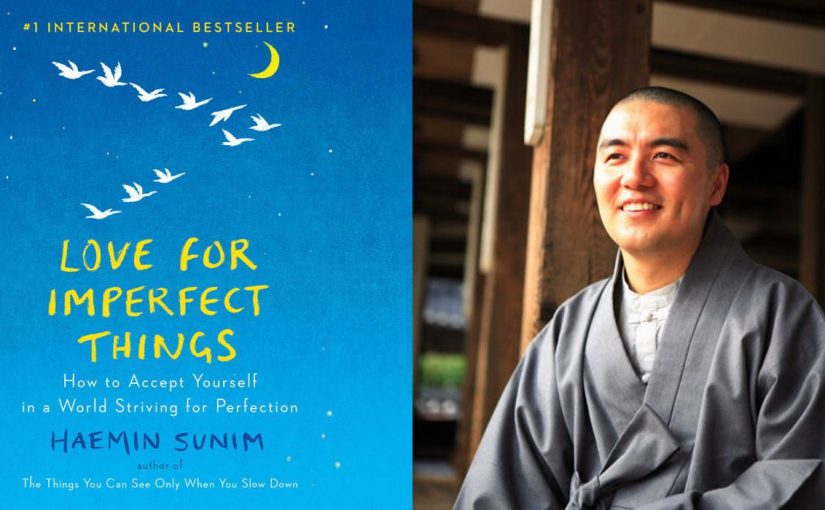
I have to admit I was surprised when I found the glowingly positive reviews for Haemin Sunim’s Love for Imperfect Things. I can’t remember why I added it to my to-read list. It might have been the title itself, which I like a great deal. I liked the cover art. It might have been driven by my occasional interest in Buddhism and my larger interest in mindfulness meditation. The brevity was surely part of the calculus. The audiobook, narrated by Raymond Lee, clocks in at just over four hours. This time of year, when I frequently find myself looking to make up for lost time on my Goodreads Reading Challenge, I’m often on the lookout for shorter books.
I didn’t care for it. That’s the top line. It’s not terrible. It’s just not my cup of tea. If you loved it or it changed your life for the better, stop reading now, gentle reader. Go to Neal.fun, Thisissand, or, hewing closer to the theme, PixelThoughts. It’s not my goal to steal your joy with my crotchety review.

Okay, I see you’re still here. Let’s continue.
I tend to take the same point of view toward spiritual advice that I do toward dietary supplements. They both might work. But, as neither is held up to any real scrutiny, how would you ever know?
While not without its charm, and not without some good advice, a lot of the wisdom offered by Haemin (“Sunim,” I learned, is not a last name but a title, meaning “monk.”) in Love for Imperfect Things seems little better than what you’d expect to find in a perceptive horoscope or a pithy fortune cookie proverb. The advice in all of these can be good advice (even a stopped clock, as they say, tells the right time twice a day), but there’s no principle, in the text at least, by which you might sort the good from the bad, the well substantiated from the just guessing. Most of the advice is the middle-of-the-road sort of thing you’ve heard a thousand times before:
When we help other people,
rather than thinking, “I am helping them for their sake,”
think, “I am doing this because I enjoy helping people.”
Even if the people you help end up
not returning the favor, you won’t be so upset.
The book alternates between sections of prose and sections that are either aphorisms or poems, as the example above. Here’s another:
I think the process of healing begins when we open
our hearts and listen empathetically.
We can help people not because
we know the solutions to their problems,
but because we care enough to stay and lend our ears.
Knowing that others have gone through similar difficulties,
they become better equipped to cope with theirs.
I mean, sure. Of course. Also, water is wet. They’re not all so common. I like this one:
The good driver sees the organic flow
of all the cars on the road
and becomes one with the flow upon joining it.
The bad driver does not see this flow as a whole,
and thinks only of how he himself is driving.
Driving is a pretty useful metaphor for many things. When I stare out at the open road from the windshield of a car, I often think of this one-liner from Jean Baudrillard’s America (1986):
“Driving is a spectacular form of amnesia. Everything is to be discovered, everything to be obliterated.” –Jean Baudrillard
Haemin is a Buddhist monk from South Korea, in the Seon tradition (the Korean inflection of what, in Japan, is the Zen tradition). In addition to the formal training required of monks, he also went the academic route, starting off as an undergraduate film major before switching to studying religions, eventually acquiring a B.A. in Religious Studies (University California, Berkley), a Master of Theological Studies from Harvard Divinity School, and a Ph.D. in Religious Studies from Princeton. His formal training in Buddhism ran concurrently with his academic pursuits. Thus, he’s clearly no dummy.
I was surprised his degrees aren’t in psychology or counseling, because a lot of the advice Haemin offers in Love for Imperfect Things would make more sense coming from someone with expertise in those areas.
And this, I suppose, is my main issue with the book. Wisdom can be found in every discipline as well as outside of them. No degree, after all, assures accuracy, much less honesty. But handing out life advice as if you were an expert in it can be reckless, even dangerous. There’s really not much risk of that here, because most of the advice Haemin hands out is harmless, unoriginal, and inoffensive. And Haemin, to his credit, at one point says, as he’s discussing depression, that you might need help from a therapist. But it bothered me, repeatedly, as I was working my way through the book, that so much of the advice was of this sort. It would be like me handing out advice on how to repair a carburetor.
Looking around the web for a critical review, I found very few. Everyone seems to love this book. You have to really dig to find any criticism of it. One Goodreads reviewer called it “a banal trawl through the blindingly obvious.”
I don’t doubt that Haemin’s goal is to do some good in the world, nor that he’s accomplishing it. He founded the wonderfully named School Broken Hearts in Seoul which, in addition to teaching Buddhist meditation, provides therapy from therapists in a variety of traditions. “The school also provides personal counseling and has eight therapists on staff from other religious traditions, including Protestantism and Catholicism,” notes Emma Varvaloucas in “How Korea’s ‘Twitter Monk’ Mends Broken Hearts” for the Buddhist magazine, Tricycle.
The print copy of the book is nicely illustrated by Lisk Feng. Perhaps the addition of her lovely work transforms this banal collection of advice into a warm, comforting blanket. I was unaware of the illustrations when I checked the book out via Libby. Audiobooks have their limitations. If you have never heard anyone tell you you’re enough, just as you are, then Haemin Sunim’s gentle words might be just the salve you need. It is a rough world out there. We all need our comforts. Mine include chicken fried steak, Dateline, and coffee with far too much cream. Buddhist reflections are probably better for you.

You’re “Kenough,” okay? Seriously. Play us out, Haemin:
Don’t think you are lovable
Only with you succeed at what the world demands.
You are already worthy of love.
You know what? I might have ended up liking this book more than I wanted to. In my quest to describe just how annoying I found it, I keep stumbling over the good parts, like Haemin’s stories about his father. It’s a far better book when he gets specific and autobiographical. For all its problems, the book’s heart is, at least, in the right place. And we could probably use more of that.